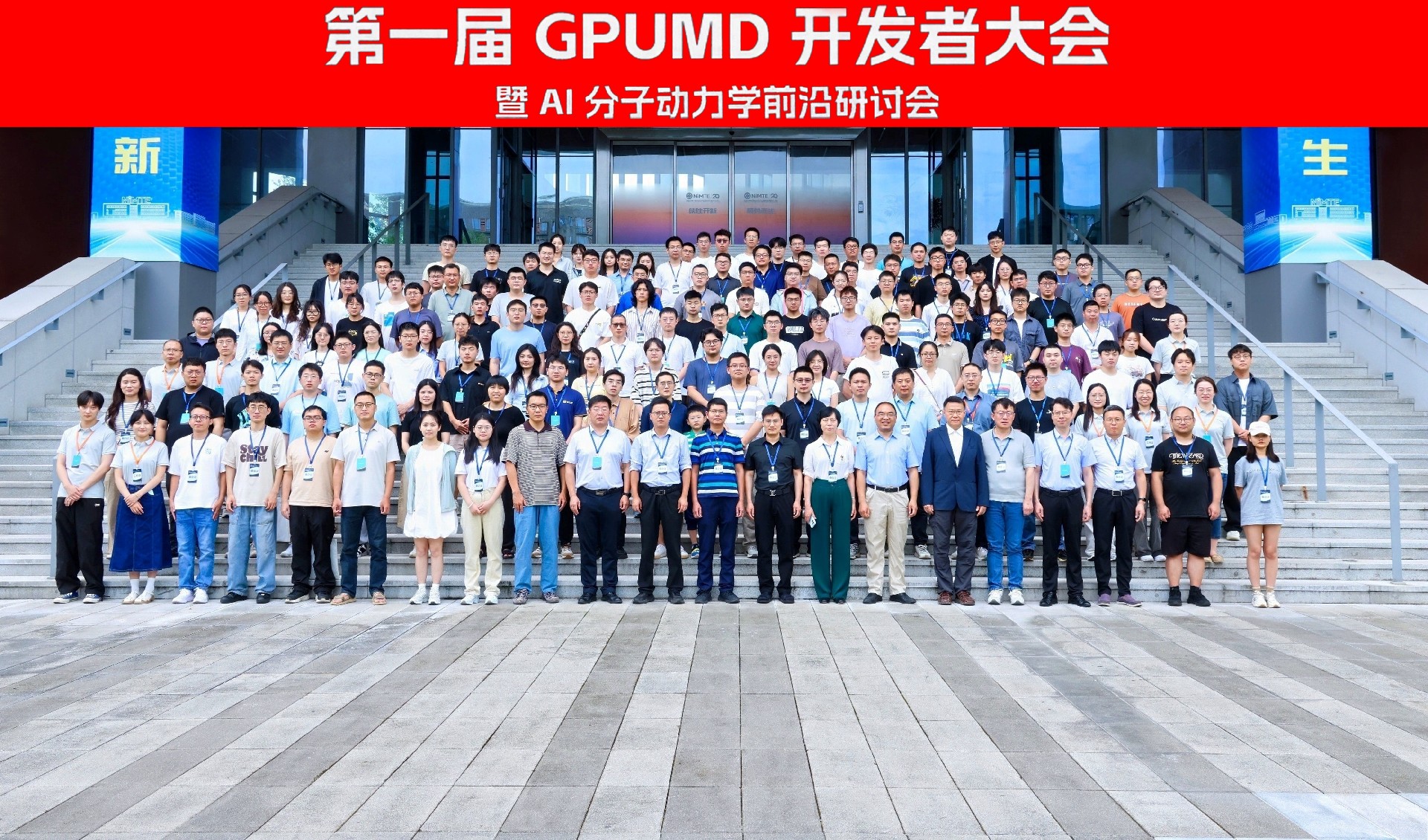
On November 30, 2024, GPUMD successfully held its first online developer meeting. The meeting brought together researchers and developers from all over the country to discuss the current status, future planning, and development direction of new features of GPUMD. The meeting was hosted by Dr. Zheyong Fan, the maintainer of GPUMD, with active participation from numerous developers, making it a complete success.
1. Current Status and Development of GPUMD
Since the release of version 1.0 in August 2017, GPUMD has developed rapidly and has become an important tool in the field of molecular dynamics simulation. As of August this year, the lines of code in the latest released version 3.9.5 have grown from the initial ~10,000 lines to over 60,000 lines. GPUMD's code is hosted on GitHub, and all developers contribute voluntarily and can join or exit at any time. Over the past few years, GPUMD has been continuously optimized and expanded, characterized by fast running speed and rich features, and is committed to reducing external dependencies to provide users with a concise and efficient simulation experience.
2. Developer Guide and Environment
To help both new and experienced developers better participate in the development of GPUMD, the team has compiled a detailed developer guide covering code management, submitting Pull Requests, and setting up the development environment. Developers can work in both Windows and Linux environments and need to be familiar with programming languages such as C++ and CUDA. The development of GPUMD emphasizes code management and review. All code changes must be submitted via Pull Requests on GitHub and reviewed by other developers. This not only ensures code quality but also promotes communication and learning among developers.
3. Modular Code Architecture
The code of GPUMD adopts a highly modular design, mainly divided into the following parts:
Force Module
Responsible for calculating the energy and force of the system, including implementations of various potentials like NEP, SW, EAM, LJ, etc.
Integrate Module
Implements different integration methods and dynamic simulations, such as NVE, NVT, NPT, etc.
Measure Module
Used to calculate various physical properties of the system, such as temperature, pressure, radial distribution function, etc.
Minimize Module
Used for energy minimization and structure optimization, supporting multiple algorithms.
Monte Carlo Module
Implements Monte Carlo simulation methods, enhancing the ability to study statistical properties.
This modular design makes the expansion and maintenance of GPUMD's functions more convenient, and also helps new developers get started quickly.
4. Future Development Plan
4.1 Version Release Plan
During the meeting, more than 30 developers jointly discussed the future version release plan for GPUMD:
- Spring 2025: Release version 4.0, expected to exceed 70,000 lines of code.
- Summer 2026: Release version 5.0, expected to exceed 90,000 lines of code.
- Autumn 2027: Release version 6.0, expected to exceed 100,000 lines of code.
4.2 Direction for New Features
(1) NEP Model Development Plan
- NEP Error Estimation (Double Precision): Develop error estimation methods for NEP potentials to improve reliability and accuracy.
- NEP + Message Passing: Combine with message passing mechanisms to further improve the calculation accuracy of NEP.
- NEP + Charge: Introduce charge into the NEP model to support simulations of charged systems and electrochemical processes.
- TNEP: Develop Tensor NEP models to expand the types of physical quantities NEP can predict.
- NEP + Spin: Add spin degrees of freedom to support simulations of magnetic materials.
- NEP Training Acceleration: Use optimization algorithms like gradient descent to accelerate training efficiency.
- NEP Large Models: Develop ML potential large models supporting complex systems with 20, 45, and 89 elements.
- TB Parameter ML Fitting: Use ML to fit Tight-Binding (TB) models for electronic structure and transport calculations.
(2) Force Fields
- Deep Potential (DP) Interface: Plan to integrate DP in v4.0.
- Expansion of ML Potentials: Consider integrating other ML potentials for comparison.
- Improvement of Empirical Potentials: Optimize ILP, SW, multi-body EAM, OPLS, etc.
- Charge and Electric Field Effects: Support Coulomb forces and external electric fields.
(3) Time Evolution and Sampling Methods
- Energy Minimization with Variable Box: Support stress relaxation and phase transition studies.
- Enhanced Sampling Methods: Develop built-in enhanced sampling algorithms (e.g., hyperdynamics).
- Expansion of MC Simulations: Support more statistical ensembles.
(4) Physical Property Calculations
- Structural Analysis: Add Angular Distribution Function (ADF), Coordination Number (CN), Bond Orientation Parameters (Q4, Q6), etc.
- Mechanical Simulation: Improve calculation functions for material mechanics (friction, tension, rheology).
- Material Growth Simulation: Simulate growth processes based on atomic deposition methods.
- Fluid Heat Transport: Calculate thermal conductivity using non-equilibrium methods.
- Electron Transport: Simulate electronic transport properties combining LSQT and TB models.
- Elastic Constants and Phonons: Support finite temperature and double-precision calculations.
(5) Program Optimization & Parallel Computing
- Code refactoring and performance optimization
- Introduce MPI parallel computing for cross-node support
- Multi-hardware compatibility: AMD GPU and domestic GPU support
- Consider supporting pure CPU calculations
(6) Tools and Ecosystem
- Enrich examples and tutorial files
- Collaborate with DP Technology's "Bohrium Platform" for tutorials
- Strengthen community building and encourage discussions
5. Inviting More Developers to Participate
The development of GPUMD cannot be separated from the support and contributions of the vast developer community. We will maintain an open development model: whether you are a student, a teacher, or another scientific researcher, as long as you are interested in the development of GPUMD, you are welcome to join the developer team at any time.
Everyone's development activities are spontaneous and without mandatory obligations. Developers can withdraw at any time. In return, developers with substantial contributions will have the opportunity to be listed as co-authors in future papers corresponding to major GPUMD version releases.
6. Conclusion
The successful convening of the first GPUMD Developers Meeting marks that GPUMD has officially entered a new stage of development. By brainstorming and collaborating, GPUMD will continuously improve its functions, enhance performance, and meet the needs of scientific researchers for efficient molecular dynamics simulations. We look forward to more developers and users joining the GPUMD family to jointly promote the development of the molecular dynamics simulation field and contribute to scientific research.