Recently, Science published the latest research work on short-range order in semiconductor alloys by a collaborative team from Lawrence Berkeley National Laboratory and George Washington University (Science 389, 1342-1346 (2025)). This work is the first to directly capture and quantitatively characterize short-range order (SRO) in semiconductor alloys in experiments, opening up new avenues for performance control of microelectronics and quantum devices. This breakthrough is attributed to the joint application of energy filtering four-dimensional scanning transmission electron microscopy (EF-4D-STEM), GPU-accelerated high-precision machine learning neuroevolution potential (GPUMD & NEP), and electron diffraction simulation (abTEM).
Background
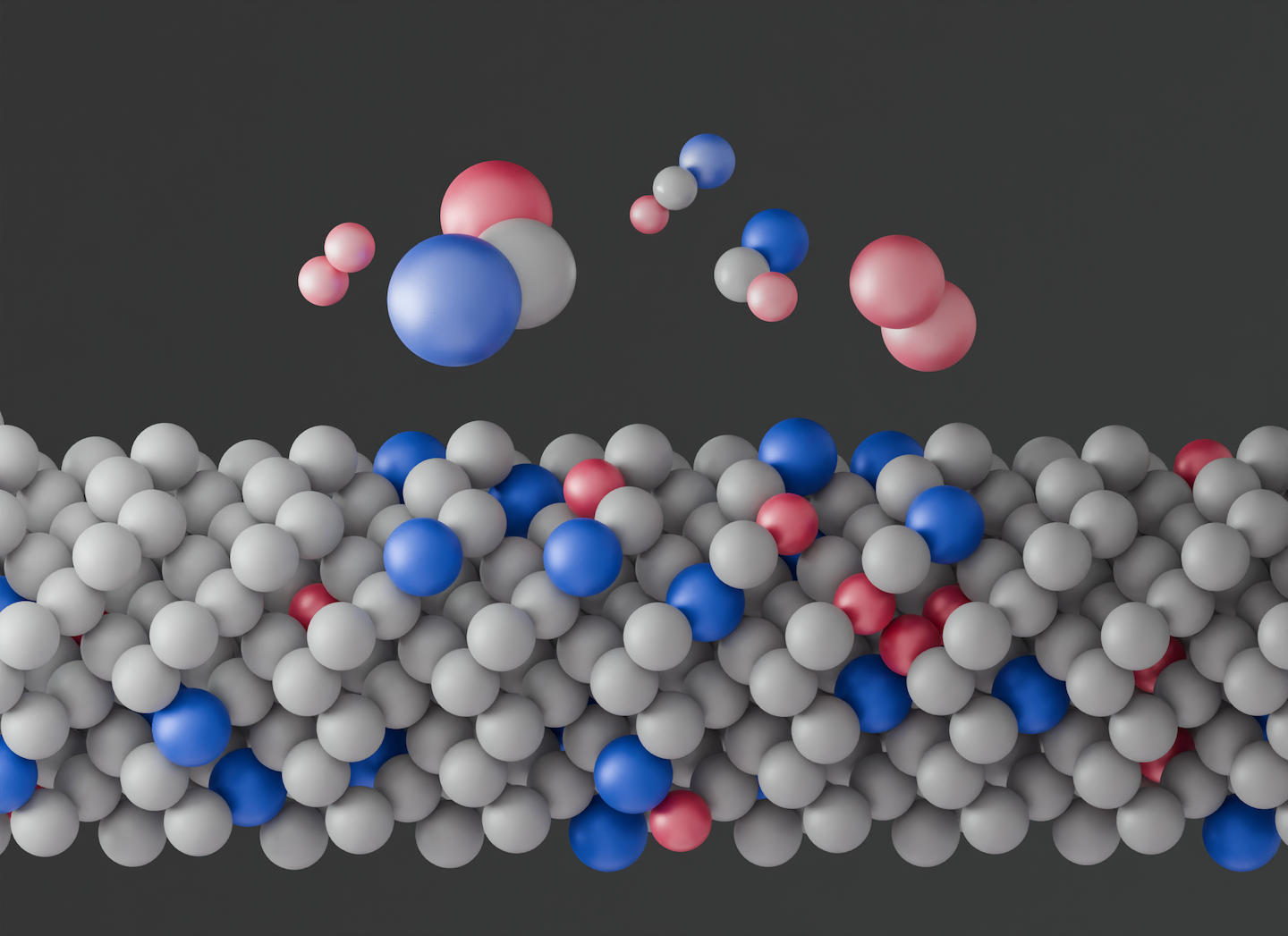
Short-Range Order (SRO) refers to the statistical arrangement preference of atoms within a local neighborhood. In simple terms, atoms in semiconductor alloy materials are not randomly distributed, but form local "friend circles" - some atoms like to "huddle together for warmth", while others repel each other, as if "one mountain cannot accommodate two tigers".
Theoretical studies have shown that this subtle local preference affects the electronic band structure of semiconductor alloy materials, thereby affecting material performance [ACS Applied Materials & Interfaces 12, 57245 (2020); Communications Materials 3, 66 (2022); Phys. Rev. Materials 7, L111601 (2023); npj Computational Materials 10, 82 (2024); Phys. Rev. Materials 8, 043805 (2024)]. However, due to its extremely small scale and statistical nature, it has long been difficult for scientists to directly observe SRO in semiconductor alloy systems in experiments.
Methods
The research team took the GeSiSn semiconductor alloy as a representative system and combined multiple advanced experimental and simulation methods for in-depth research. The GeSiSn semiconductor alloy is a very promising silicon-based microelectronic, optoelectronic, and topological quantum material.
-
EF-4D-STEM (Energy-Filtered 4D Scanning Transmission Electron Microscopy): Captures weak diffuse scattering signals in diffraction images to reveal underlying SRO features.
-
NEP (Neuroevolution Potential): A machine learning potential that balances near first-principles accuracy with the speed of classical empirical potentials. [NEP4, Nature Communications 15, 10208 (2024); Chem. Phys. Rev. 6, 011310 (2025)]
-
GPUMD (GPU Molecular Dynamics): Extends all-atom simulations based on NEP models to the million-atom level, generating atomic models at the same scale as experiments. [GPUMD 4.0, MGE Advances 3, e70028 (2025)]
-
abTEM: Performs electron diffraction simulations on large-scale models and compares them point-by-point with experimental data to achieve precise correspondence. [Open Res. Eur. 1, 24 (2021)]
This comprehensive "experiment + simulation combination" achieved a one-to-one correspondence between million-atom scale simulations and experimental results, making precise capture of the atomic "friend circle" (SRO) possible.
Results
- Based on a rich and high-quality first-principles (DFT) training set, the team constructed a high-precision NEP and used GPUMD to build a million-atom SRO model.
- Through the comparison of EF-4D-STEM experiments and abTEM large-scale simulations, the SRO in GeSiSn semiconductor alloys was directly confirmed and quantitatively characterized for the first time.
- Research showed that the Si-Ge-Sn ternary atomic configuration is the dominant SRO structure in this system, providing an atomic-level reference for material performance tuning.
Significance
- First experimental verification of semiconductor short-range order, filling a long-term gap and providing new pathways for bandgap and electronic property tuning.
- Demonstrated the feasibility and advantages of NEP and GPUMD in million-atom scale simulations of complex alloy materials.
- SRO is expected to become the "third degree of freedom" beyond composition and strain, providing new ideas for the design of next-generation microelectronics, optoelectronics, quantum materials, and neuromorphic chips.
Perspectives
In the future, scientists may be able to achieve fine tuning of material properties by designing atomic neighborhood "friend circles" (short-range order) just like "building blocks". This could lead to breakthroughs in advanced microelectronics, quantum devices, novel optoelectronic materials, and even neuromorphic chips. At the same time, NEP and GPUMD will play an even greater role in multi-scale simulations of complex materials.
Paper Information
Lilian M. Vogl, Shunda Chen, Peter Schweizer, Xiaochen Jin, Shui-Qing Yu, Jifeng Liu, Tianshu Li, Andrew M. Minor.
“Identification of short-range ordering motifs in semiconductors”.
Science, 389, 1342–1346 (2025).
Full Text Link: https://www.science.org/doi/10.1126/science.adu0719
Chemical short-range ordering is expected to be a key factor for tuning the electronic structure of semiconductors. However, experimental evidence of short-range ordering is still lacking due to the challenge of characterizing atomic-scale ordering motifs. Here, we determined the presence of short-range order in a ternary GeSiSn semiconductor system using advanced energy-filtered four-dimensional scanning transmission electron microscopy and large-scale atomistic models generated by a machine learning neuroevolution potential of first-principles accuracy. This approach revealed preferred ordering of different atomic species with the dominant occurrence of Si–Ge–Sn triplets. Our findings not only confirmed the presence of short-range order but also directly revealed the actual atomic structure, demonstrating the potential for informed atomic order–based band engineering as a third degree of freedom beyond composition and strain tuning.
Short-range order (SRO) refers to the tendency of atoms to arrange themselves in a crystal lattice over small distances (typically less than a few nanometers) without forming a fully ordered compound at long ranges. SRO in metals has been linked to properties of mechanical deformation, and in ceramics has been linked to properties related to diffusion. In semiconductors, the concept of SRO has only rarely been studied beyond theoretical predictions linking SRO to important changes in electronic band structure. Using energy-filtered electron microscopy and complementary simulations, Vogl et al. confirmed the presence of SRO in a germanium-silicon-tin semiconductor and identified the actual atomic structure of the SRO motifs. Their work explores an exciting area for understanding and controlling SRO in semiconductors.